Delivery Australia Wide
 Award Winning Irons
 Professional Iron For Home Use
 Established Over 40 Years
How to Iron Wool Without Shine, Shrinkage or Crushed Fibres
- The correct ironing temperature for most woven wool is 130–150°C. Fine merino sits at the lower end. Knitwear (jumpers, cardigans) should be steamed without any soleplate contact at all.
- Wool shine is permanent. Once the surface fibres flatten under a hot soleplate, they stay flat. There is no reliable home fix, which makes prevention the only real answer.
- A pressing cloth is the best defence against shine when using a conventional iron. For dark garments, ironing inside out adds a second layer of protection.
- Laurastar’s DMS (Dry Microfine Steam) technology and Teflon SoftPressing soleplate remove the need for most of these workarounds, making shine, shrinkage and crushed fibres avoidable by design.
Wool is the fabric most people are most nervous about ironing, and for good reason: the most common mistake leaves a permanent mark. This guide covers the correct technique for every wool garment type using a conventional iron, why those workarounds exist, and how a Laurastar removes the problem at its source.
Why Does Wool Go Shiny When You Iron It?
Shine on woven wool is a physics problem, not a user error. Woven wool (suiting, trousers, blazers, overcoats) has a surface of interlocking fibres that scatter light at multiple angles, which gives fine wool its characteristic soft lustre. When a hot soleplate presses directly against that surface, the fibres flatten. Flattened fibres reflect light uniformly rather than scattering it, and the result is the flat, greasy sheen that appears on dark wool after ironing.
This is not a mark or a stain. It is a structural change in how the surface catches light, and it cannot be reversed.
Knit wool (jumpers, cardigans, knit dresses) fails from the same cause in a different way. Direct pressure crushes the loops of the knit rather than flattening surface fibres, producing a matted, lifeless texture. Both are damage. Both share the same origin: soleplate contact on fabric that needs handling without it.
Is Shrinkage a Risk Too?
Yes, particularly when wet wool is pressed under heat and weight at the same time. Wool protein fibres contract under heat, and the risk spikes when a cheap iron or budget steam station spits liquid water onto the fabric before pressing. The damp fibres felt and set in a shrunken position.
The safe temperature range for most woven wool suiting is 130–150°C (the wool setting on most irons). Fine merino and lightweight suits belong at the lower end of that range. Heavyweight tweed or worsted suiting can take the upper end.
For knitwear of any kind, treat it as you would fine cashmere: steam only, no soleplate contact, no exceptions.
How Do You Iron Wool Without Creating Shine?
Use a pressing cloth, iron inside out on dark garments, and keep the iron lifting rather than gliding. Here is the full technique, in order:
- Check the care label: A one-dot or two-dot iron symbol means ironing at the correct setting is appropriate. Some fine wool garments and most structured knitwear are steam-only or dry clean only.
- Set the iron to the wool setting (130–150°C): Fine merino at the lower end, heavyweight tweed at the upper end. Never use the cotton or linen setting on wool.
- Use a pressing cloth: A clean, dry cotton or muslin cloth placed between the soleplate and the wool fabric is the primary defence against shine. It diffuses heat and breaks direct contact between plate and fibre.
- Iron inside out where the construction allows: Dark trousers, coat linings, and jacket facings pressed inside out put the visible surface away from the soleplate entirely.
- Use steam lightly: A moderate steam setting helps relax fibres and release creases more effectively than dry heat. Over-saturating damp wool under pressure is where shrinkage risk increases.
- Lift, do not glide: Move the iron in short, lifting strokes rather than continuous passes. Continuous pressure concentrates heat in one direction and increases shine risk.
- Hang immediately and allow to cool: Wool holds its new shape best when it cools under tension. Folding or wearing a warm wool garment sets new creases.
How Do You Iron a Wool Suit Without Marking It?
A suit jacket requires different handling from a pair of trousers. The construction (canvas interlining, chest padding, sleeve head) means it cannot be pressed flat the way a trouser leg can.
For the jacket:
- Press lapels from the underside only. Never iron the visible face of a lapel directly.
- For the chest and front panels, use a pressing cloth and short lifting strokes. Work around the canvas, not across it.
- For sleeves, use a sleeve board or a tightly rolled towel inside to maintain the sleeve head shape. Press around the sleeve head rather than over it.
For the trousers:
- Lightly mist the crease line with distilled water and leave it for a minute before pressing.
- Place the pressing cloth over the crease line and press with a flat, stationary iron for a few seconds. Lift. Repeat along the length of the crease.
- For the seat and thighs, press inside out with a pressing cloth and short strokes.
Structured jacket pressing is where a flat iron on a standard board becomes genuinely awkward. The three-dimensional construction of a jacket shoulder and lapel requires access a flat surface cannot provide cleanly.
How Does a Laurastar Handle Wool Differently?
Every workaround in the conventional technique above exists because soleplate contact on wool causes damage, and standard irons rely on soleplate contact to work. The pressing cloth protects against shine because the soleplate would cause it. Ironing inside out protects the visible surface because the soleplate cannot be trusted against it. The lifting strokes, the distilled water, the careful lapel handling: all of it is damage mitigation for a tool not designed with fine fabric in mind.
A Laurastar approaches the problem differently in three ways.
- Vertical steaming first. Every Laurastar ironing system steams vertically. Hang the garment, bring the iron to the fabric, and let the powerful DMS (Dry Microfine Steam) pass through it. Creases drop out while the garment hangs in its natural shape. No flat board, no pressure, no soleplate contact. For most wool, including jumpers, knitwear, jackets, coats, and suiting that just needs refreshing, this is the whole job.
- The Teflon SoftPressing soleplate. When you do want a flat finish or a sharp crease, clip on the SoftPressing soleplate. It sits over the hot soleplate so the fabric never contacts bare metal. You keep full steam and temperature, but the Teflon barrier removes the shine risk entirely. No pressing cloth needed. No ironing inside out. No dropping the temperature. Glide smoothly over the surface in normal passes.
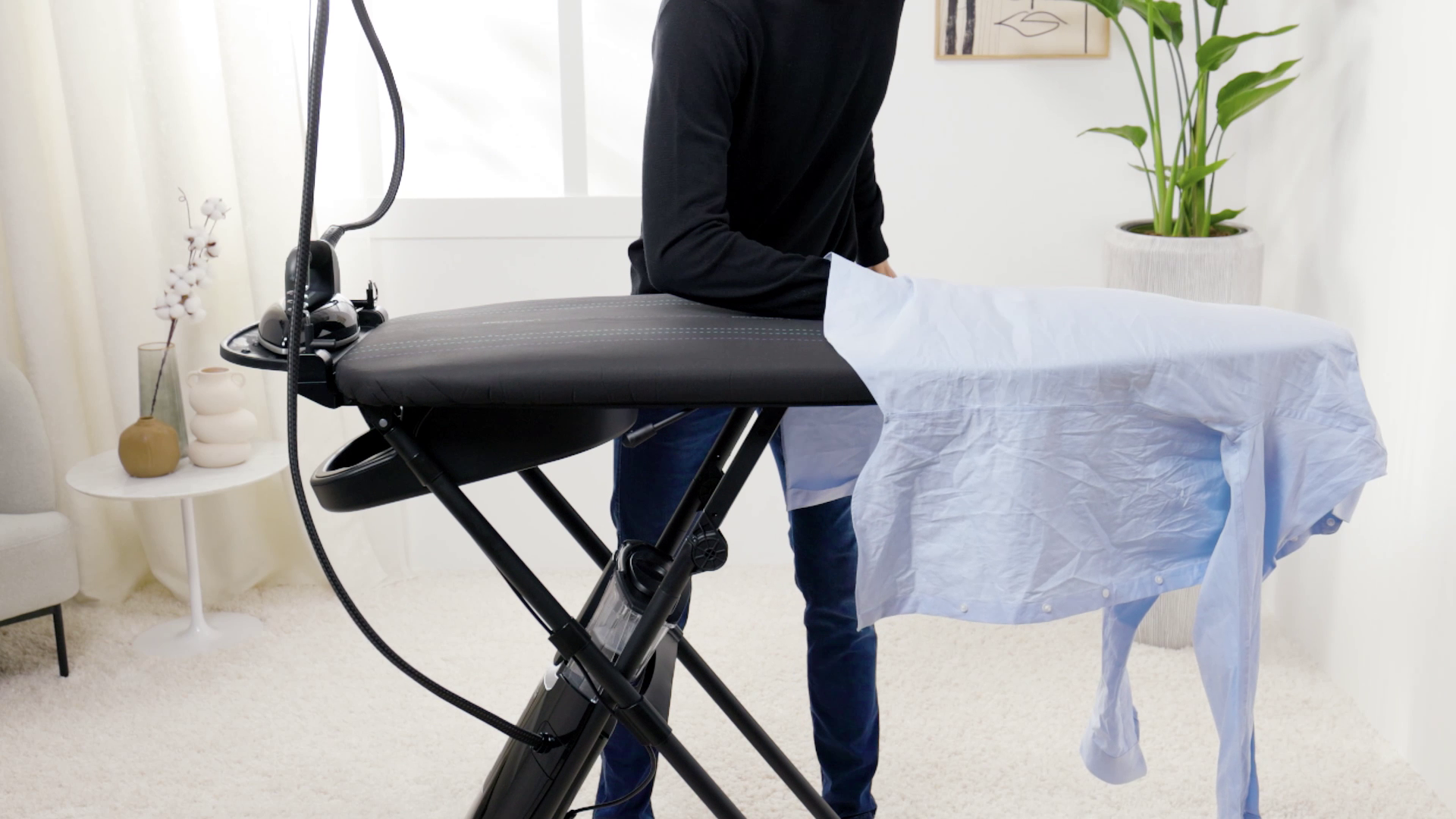
- The Active Board for structured garments. For suit jackets pressed flat, the Active Board’s blower lifts fabric on a cushion of air so the iron never bears down hard against the construction. Switch to the vacuum function to hold the fabric locked in place for a single, sharp trouser crease. This combination is the part of the job a flat iron on a standard board cannot replicate.
Is Steaming Wool Better Than Ironing It?
For most wool garments, yes. Here is the right method by garment type:
- Knitwear (jumpers, cardigans, knit dresses): Vertical steam only. Hold the iron close and let the DMS lift the fibres. Direct ironing of knit wool, even with a pressing cloth, risks crushing the loop structure permanently.
- Woven suiting and jackets: Steam vertically to refresh and de-crease. Only reach for flat pressing when you specifically want a sharp crease, and use the Teflon shoe with the Active Board when you do.
- Coats and heavy outerwear: Steam vertically while the garment hangs in its natural shape. Pressing a wool coat flat distorts the shoulder.
Here is how the three tools compare on wool specifically:
| Standard iron | Ordinary steam station | Laurastar | |
|---|---|---|---|
| Vertical steaming | No | Limited | Yes, all models |
| Steam type | None or wet/spitting | Often wet, can drip | Dry Microfine Steam, fabric stays dry |
| Shine prevention when pressing flat | Lower the dial and hope | Limited | Teflon SoftPressing soleplate |
| Shrinkage risk | Real if fabric is wet under heat | Real, wets the fabric | Minimal, very little water on the fibre |
| Suit jacket handling | Awkward, high shine risk | Partial | Vertical steam, or Active Board blower |
| Sharp crease setting | Yes, with shine risk | Limited | Active Board vacuum and Teflon shoe |
| Wool knitwear | Risky | Yes | Vertical steam, no contact |
| Hygiene (bacteria, dust mites) | None | Limited | Removed deep in the fibres by DMS |
Can You Get Wool Shine Out Once It’s There?
No. This is worth being clear about. Wool shine is not dirt or a surface coating: it is the surface fibres themselves, physically flattened. Steaming and brushing a very recent, very light mark may soften its appearance slightly. But the structural change is done, and there is no reliable home fix. Even a specialist dry cleaner can rarely restore a flattened dark jacket to its original finish.
That is why the tool matters. Because the damage is permanent, protection is the only real answer.
Frequently Asked Questions About Ironing Wool
- Can you iron wool? Yes, with the right settings and technique. Use the wool setting (130–150°C), a clean pressing cloth between iron and fabric, and short lifting strokes. Iron inside out on dark garments. Wool knitwear should be steamed without direct contact rather than ironed. With a Laurastar, the better first move is usually to steam vertically and skip the board altogether.
- Can you get shine out of wool? Shine on wool is a permanent structural change and cannot be reliably reversed at home. Holding a steamer near the affected area without contact may soften a very recent, very light mark slightly, but significant shine does not reverse. Prevention is the only answer.
- What temperature should you iron wool at? The wool setting runs at 130–150°C on most irons. Fine merino and lightweight suiting at the lower end; heavyweight tweed or worsted at the upper end. Knitwear should not be ironed with direct soleplate contact at any temperature. With a Laurastar and the Teflon SoftPressing soleplate, you do not need to drop the temperature at all.
- Is it better to steam or iron a wool suit? Steam in most cases. Steam the jacket vertically so it keeps its shape with no pressure on it. Steam the trousers vertically first, then set a sharp crease using the Active Board vacuum and Teflon shoe.
- Why does a Laurastar handle wool better than a regular iron? It steams garments vertically, so most wool never needs pressing and never risks shine. Its Dry Microfine Steam keeps fabric dry, reducing the shrinkage that wet steam from standard irons and steam stations causes. Its Teflon SoftPressing soleplate removes the shine risk when you do press flat. The Active Board’s blower and vacuum let you finish structured garments and sharp creases without pressure marks.
Wool is a forgiving fabric with the right tool and an unforgiving one with the wrong one, because the most common damage is permanent. Almost all of it comes from soleplate contact and wet steam. If you want to see what vertical DMS steaming, the Teflon SoftPressing soleplate, and the Active Board do to a wool jacket in practice, Laurastar showrooms in Melbourne, Sydney, Brisbane, Adelaide, and Perth offer no-obligation demonstrations. Bring your own jacket.
You can also read our guide to Is a Laurastar Worth the Money? if you are weighing whether a DMS system makes sense for your wardrobe.