What Is DMS Technology? The Science That Makes Laurastar Different
- Dryness, not heat or speed, is the property that determines the outcome: DMS leaves the appliance in a 100% gaseous state with no water molecules in their liquid form, unlike conventional steam irons.
- That dryness is what allows DMS to penetrate fabric at the fibre level instead of settling on the surface, which is the mechanism behind avoiding water spotting, sheen marks, and puckering on delicate fabrics.
- Independent ISO 17025 certified laboratories have tested DMS’s hygiene performance, certifying kill rates of 100% of lice and mites and over 99.999% of bacteria, viruses, fungi, and dust mites.
Every steam iron claims to produce steam. DMS technology is a specific, patented answer to a narrower question: what happens if that steam never contains liquid water at all. The difference between “steam” as a general term and Dry Microfine Steam as a defined mechanism is exactly what explains why some fabrics come off a Laurastar dry and crisp when the same fabric comes off a standard steam iron faintly damp, marked, or shiny.
DMS stands for Dry Microfine Steam
The name describes the mechanism directly rather than being a marketing label attached after the fact. Dry Microfine Steam is Laurastar’s engineered steam technology, produced by a boiler system built specifically to superheat water well past its usual boiling point and expel it as fine, high-energy steam particles rather than a coarser, wetter vapour.
Laurastar states DMS reaches temperatures of up to 160°C, travelling at speeds of up to 129 km/h as it leaves the appliance. Both figures sit well above what a standard steam iron or steam station produces, but the temperature and speed aren’t the part that changes the outcome on fabric. That comes down to a different property entirely.
The physics of superheated steam
The term “superheated steam” has a specific meaning in thermodynamics, not just marketing shorthand. Ordinary steam at boiling point is saturated steam, meaning it sits right at the temperature where water and vapour are in equilibrium, and any tiny drop in temperature causes some of it to condense back into liquid droplets. Superheated steam is heated well beyond that saturation point, which keeps it purely gaseous with far less tendency to condense on contact with a cooler surface, like fabric.
This is a well-established distinction in physics generally, not something specific to Laurastar. What Laurastar has engineered is a boiler system designed to reach and sustain that superheated state specifically for a handheld ironing and steaming appliance, a harder engineering problem than achieving it in an industrial setting with more space and power available. The practical result is steam that’s less likely to condense into the liquid droplets that cause surface moisture in the first place.
The physical property that actually matters dryness, not heat
A standard iron or steam station heats water into pressurised steam and pushes it through the soleplate. That steam still carries water in its liquid form, fine droplets suspended in the vapour, which is what lands on the fabric surface as moisture.
DMS works differently at the point of generation. Laurastar describes it as existing in a 100% gaseous state as it leaves the appliance, containing no water molecules in their liquid form at all. That’s the property doing the actual work. Heat and speed help the steam move efficiently through fabric, but it’s the absence of liquid water that determines what happens when the steam meets the fibre.
Wet steam sits on the surface, dry steam penetrates the fibre
This is the fabric-science distinction that explains most of what people notice as a practical difference between a Laurastar and a conventional iron or steam station.
Wet, pressurised steam behaves like any moisture landing on a surface: it settles unevenly, particularly on textured, dark, or loosely woven fabric, and that uneven settling is what shows up later as water spotting, ring marks, or a change in sheen once the fabric dries. That’s a predictable outcome of putting liquid moisture on a surface that absorbs it inconsistently, not a fault in technique.
A gaseous steam with no liquid water component doesn’t have that problem to begin with. Because there’s no liquid phase to deposit unevenly, DMS moves into the fibre structure itself rather than sitting on top of it. That’s the mechanism behind a fabric coming off dry to the touch immediately, rather than damp and needing time to air out.
Fibre-level penetration matters most on delicate fabrics
The difference between surface moisture and fibre-level steam is measurable on any fabric, but it’s most visible on the ones that already have the least tolerance for excess moisture or direct heat.
Silk and fine wool are where wet steam’s uneven moisture shows up fastest, as sheen marks or water spotting, particularly on darker colours where any surface change is obvious. Our guides to ironing silk and ironing wool cover these failure points in more depth. Cashmere adds a second risk on top of moisture: its fine fibres felt permanently under sustained heat and pressure, which is covered in our guide to caring for cashmere. Linen sits closer to the durable end of the spectrum, but its dense weave still needs more heat and contact time from a standard iron to release a crease, which is where DMS’s fibre-level penetration reduces the number of passes needed rather than preventing damage specifically.
None of this means DMS is only useful on delicate. The same mechanism handles cotton and synthetic blends without issue. The difference simply becomes visible earlier and more clearly on fabrics with the least room for error.
Independent testing behind the DMS claims
A technology claim is only as strong as the testing behind it, and this is where DMS moves from a brand description to a measurable one. Laurastar states that DMS’s hygiene performance has been assessed by independent ISO 17025 certified laboratories, the accreditation standard for competent testing and calibration facilities globally.
According to Laurastar, that testing certifies DMS’s ability to eliminate 100% of lice and mites and more than 99.999% of bacteria, viruses, fungi, and dust mites on treated fabric. These figures sit within Laurastar’s Lab-L programme, a dedicated research initiative the brand describes as drawing on internal and external experts in health and hygiene to keep its testing methodology and claims scientifically grounded.
It’s worth being precise about what this testing does and doesn’t cover. It validates DMS’s hygiene performance, the ability to reduce microorganisms and pests on fabric, rather than making a separate claim about ironing results specifically. The two are related, since both stem from the same dry, high-energy steam mechanism, but they’re distinct claims worth keeping separate rather than treating one as automatic proof of the other.
Common misconceptions about DMS
A few assumptions about DMS come up often enough to address directly.
DMS is just hot steam. Temperature is part of the mechanism, but heat alone doesn’t explain the fabric-care difference. A conventional steam station could theoretically run hotter without changing its wet-steam behaviour at all. It’s the absence of liquid water, not the temperature reading, that determines whether steam sits on a surface or moves through it.
DMS and a standard steam generator are the same thing with a different name. Steam generators, including premium ones, still produce pressurised wet steam. DMS’s defining property, a 100% gaseous state with no liquid water content, is a different mechanism rather than a faster or stronger version of the same one.
DMS makes fabric completely waterproof. It doesn’t. DMS reduces the surface moisture that causes spotting and sheen during the steaming process itself, but it isn’t a fabric treatment and has no bearing on how the garment behaves in rain or wash.
Where DMS sits inside a Laurastar system
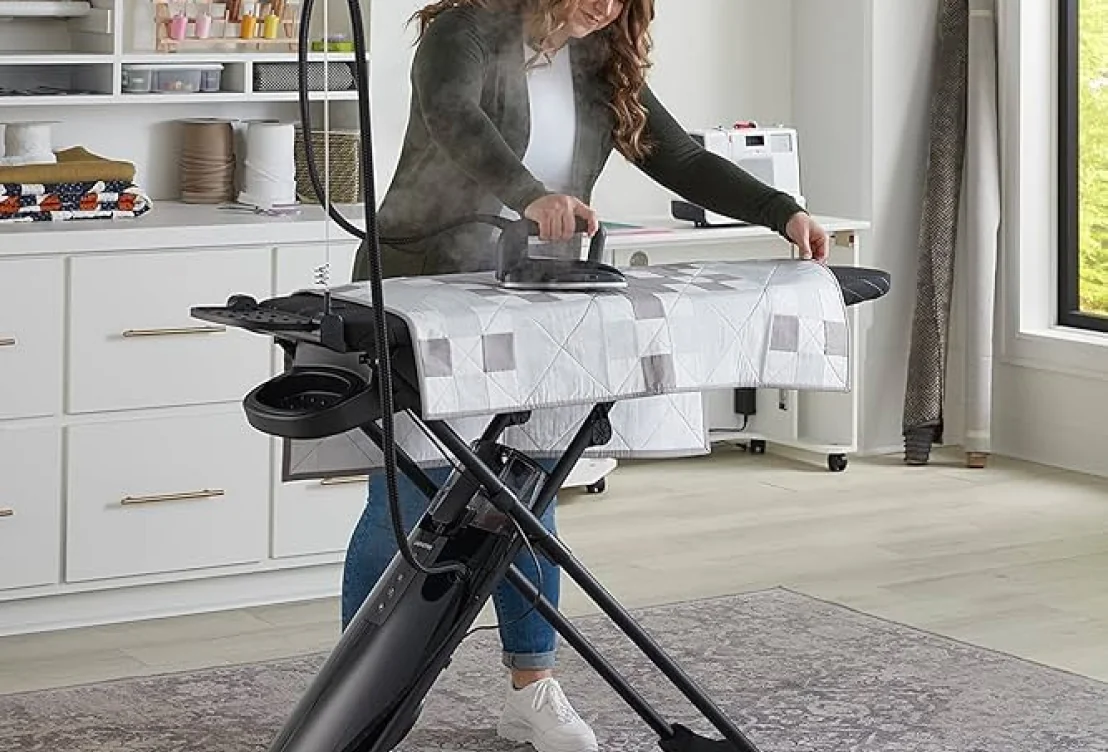
DMS is the steam technology itself, not the whole appliance, and it works alongside other features rather than replacing the need for them. The Teflon shoe included with Laurastar irons handles direct soleplate contact on fabrics where shine is a risk, working alongside DMS rather than being part of the steam mechanism itself. The Active Board’s vacuum and blower functions hold fabric in position and release it crisp, which matters most on larger flat pieces like tablecloths where an unsupported garment would shift under steam.
DMS runs across Laurastar’s ironing systems and steamers rather than being reserved for a single flagship model. The Smart U, Smart I, and S-Pure use it as part of a full ironing system with the Active Board. The Lift and Lift Xtra use the same steam mechanism in a standalone iron built for everyday use rather than a full board setup. Laurastar’s steamer range, including the IZZI Plus, applies the same dry-steam principle to hanging garments rather than pressed ones. The mechanism doesn’t change between these product lines, only the format it’s built into.
Because DMS doesn’t rely on wet steam saturating the fabric to work, Laurastar’s systems don’t need a separate temperature setting for different fabric types the way many standard irons do. The steam mechanism does the work that a temperature dial would otherwise need to compensate for, which is also why the manufacturing side of these matters. A steam mechanism engineered to a consistent standard, rather than a dial a user must get right, is part of why Laurastar builds its systems around a 20-year design lifespan rather than a shorter replacement cycle. The technology is designed to perform the same way on day one and year fifteen, not to be recalibrated by the person using it.
Frequently asked questions about DMS technology
What does DMS stand for?
DMS stands for Dry Microfine Steam, Laurastar’s engineered steam technology. It’s the name of the mechanism itself, referring specifically to steam that exists in a 100% gaseous state with no liquid water content, rather than a general marketing term for “better steam.”
How is DMS different from regular steam iron technology?
Regular steam irons produce wet, pressurised steam that carries liquid water droplets onto the fabric surface. DMS is generated and expelled as a fully gaseous steam with no liquid water component, which is what allows it to penetrate fabric fibres rather than depositing surface moisture.
Is DMS technology tested, or is it a marketing claim?
Laurastar states that DMS’s hygiene performance has been assessed by independent ISO 17025 certified laboratories, which is a recognised accreditation standard for testing facilities. According to Laurastar, this testing certifies kill rates against lice, mites, bacteria, viruses, fungi, and dust mites, figures published through the brand’s Lab-L research programme.
Does DMS technology work on all fabrics, or just delicate ones?
DMS works the same way on any fabric, cotton and synthetic blends included, since the underlying mechanism doesn’t change by fabric type. The practical difference is most visible on delicate fabrics like silk, wool, and cashmere, where a standard iron’s wet steam is more likely to leave a visible mark.
DMS technology is a specific engineering answer to a specific problem: steam that does the work without leaving moisture behind to cause it. If you want to see the difference in person, Laurastar’s showrooms in Brisbane, Sydney, Melbourne, and Perth run no-obligation demonstrations on your own fabric.